Wall Street's Newest Product: The Coinflip
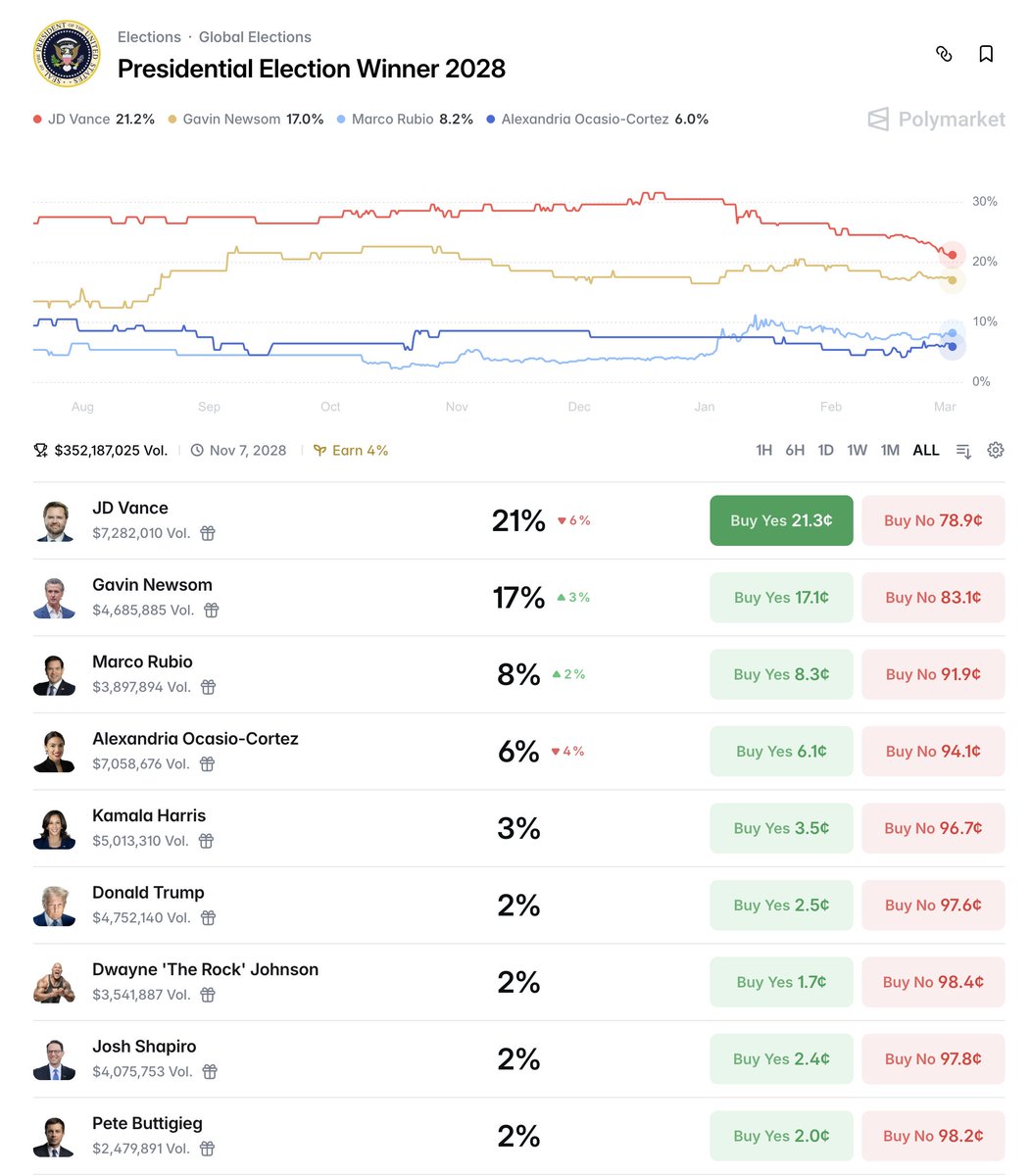
Nasdaq has filed a proposal with the SEC to list binary prediction contracts on the Nasdaq-100, joining rival exchange Cboe in the rush to bring prediction market mechanics to traditional finance. The contracts would function as yes-or-no bets on whether the tech-heavy index hits specific price targets—essentially importing the structure that made Kalshi and Polymarket household names during the 2024 election into the realm of regulated exchanges.
The timing is no accident. Cboe has already begun offering similar binary options, and demand for prediction-style instruments has exploded over the past year. Traders are now conditioned to think in probabilities rather than price targets. "On mention markets, new information is being priced in every second," noted @PredMTrader, pointing to odds on Trump mentioning Pete Hegseth that spiked from 64% to 83% the moment cameras caught him. That real-time price discovery mechanism—where odds update continuously rather than waiting for closing bells—is exactly what traditional exchanges want to capture.
The Regulatory Crossfire
But as Nasdaq pushes into this space, the backlash is intensifying. A new coalition called Gambling Is Not Investing launched Monday with a singular mission: push state attorneys general and tribal gaming authorities to crack down on prediction markets operating in jurisdictions where sports betting remains illegal. The group argues that federally regulated platforms like Kalshi are effectively running sports books in states that banned them, exploiting regulatory gray zones between the CFTC and state gaming boards.
The legal pressure is already bearing fruit. Nevada's federal court just remanded the state gaming board's civil enforcement action against Kalshi back to state court, where the platform faces an imminent temporary restraining order. "SCOTUS emergency application may be next step for Kalshi," warned @WALLACHLEGAL. The Nevada case could become a template for other states looking to block prediction markets—particularly if Nasdaq and Cboe contracts gain traction and blur the line between "financial derivatives" and "sports betting" even further.
What Nasdaq's Entry Means for Traders
For prediction market veterans, Wall Street's arrival is both validation and threat. Nasdaq brings institutional liquidity and regulatory legitimacy that could dwarf current platforms. But it also brings limitations: federally regulated exchanges can't offer the wild range of markets that make Polymarket compelling (no presidential mention bets on Nasdaq). As @vix_0ii observed, "There can be free money in unexpected places on @Kalshi. Last week, the 2 only candidates for the CAQ leadership race in Québec were selling at ~33¢ each, an easy arbitrage at 67¢ on the dollar." Those inefficiencies vanish when institutional capital floods in.
The bigger question is whether binary bets on the Nasdaq-100 will attract the retail traders who made prediction markets mainstream, or whether they'll just become another derivatives product for quants. If Nasdaq can thread that needle—offering yes-or-no simplicity with serious liquidity—they could reshape how millions of people think about market exposure. If they can't, this becomes another failed experiment in financial innovation, and the prediction market boom stays confined to unregulated platforms dodging state gaming boards.